
Child mattress should be chosen precisely according to the bed's interior dimensions and the child's age. A mattress that's too small leaves gaps, but a too large one can deform and lie incorrectly on the base.
The filling materials, surface firmness, cover maintenance, and mattress height in relation to the bed's side edges are also important. Specific safety requirements of the bed's manufacturer must be followed for an infant bed.
Accurate mattress size
The mattress should fit level and without dangerous gaps in the bed frame. The standard sizes of children's beds vary, therefore, you can't rely solely on the term "child mattress."
If the bed is made in a non-standard size, find out possibility to order a mattress with individual dimensions. Before placing an order, check what production tolerances are used.
Firmness and filling structure
The mattress for child should provide uniform support and a stable surface. The right firmness depends on the age, structure, and use intended by the manufacturer.
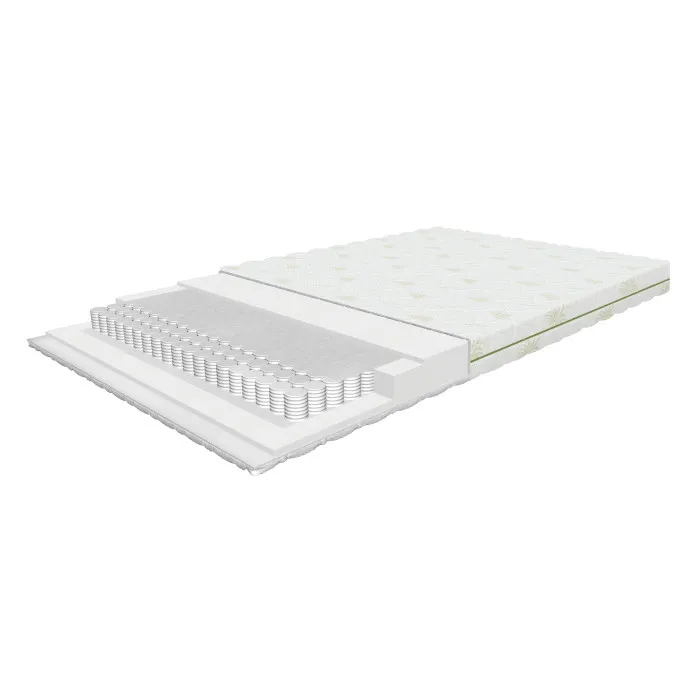
There are foam, coconut fiber, latex, and spring solutions available. Material name itself does not determine the quality — evaluate the thickness of layers, density, and the entire structure.
Cover and daily care
Removable cover eases maintenance, but check the allowed washing temperature and drying instructions. An additional mattress protector helps protect from moisture and stains.
The protector must be breathable and securely fastened so that it does not form humps. The mattress should be aired regularly and kept dry.
Mattress height and bed edges
A mattress that's too high might reduce the effective height of child bed's protective edge. This is particularly important for bunk beds, elevated beds, and infant beds.
Follow the mattress height specified by the bed's manufacturer. Do not use an additional mattress topper, if it raises the sleeping surface above the safe level.
Example of a child mattress
Check the specific model's size, construction, and possibility to order a non-standard version.
Child mattress Bouncy
The Bouncy children's mattress has mini Pocket springs and foam layers. The designated standard size is 80 × 160 × 13 cm and the manufacturer also offers ordering in non-standard size.
Mattress Amboise Pocket
In contrast, Amboise is a firm 19 cm tall Pocket mattress intended for adults. It shows why a mattress specifically designed for the bed should be chosen for a child's bed in terms of size and height.
Child mattress checklist
- The exact inner width and length of the bed frame.
- The maximum mattress height allowed by the bed's manufacturer.
- Filling layers and target age.
- Removable cover washing conditions.
- Compatibility with the bed base and slats.
- Size of the mattress protector and a secure tightening.
Frequently asked questions
Does an adult mattress suit a child?
Only if it perfectly matches the child's bed by being the right size, height, and meeting the manufacturer's requirements. Child beds often have specific safety restrictions.
Does a child mattress need a mattress topper?
Usually, it's not needed. A mattress topper can change the firmness and increase the overall height, so it should only be used if it's safe for the specific bed.
How often should the mattress be aired?
Regularly, especially after washing the cover or protector. The mattress must be completely dry before making the bed.
Choose a mattress precisely for the child's bed
The right size and safe height are the first criteria. Then compare the filling, cover, and maintenance options.