
Modular sofas allow creating a configuration from individual elements and adapting it to the shape of the room, family customs and the number of seats. This approach is especially useful in non-standard living rooms or homes that might undergo renovation in the future.
Modular does not mean that all elements are always freely movable. It should be clarified how modules are connected, which elements have armrests, and whether the specific collection can be supplemented later.
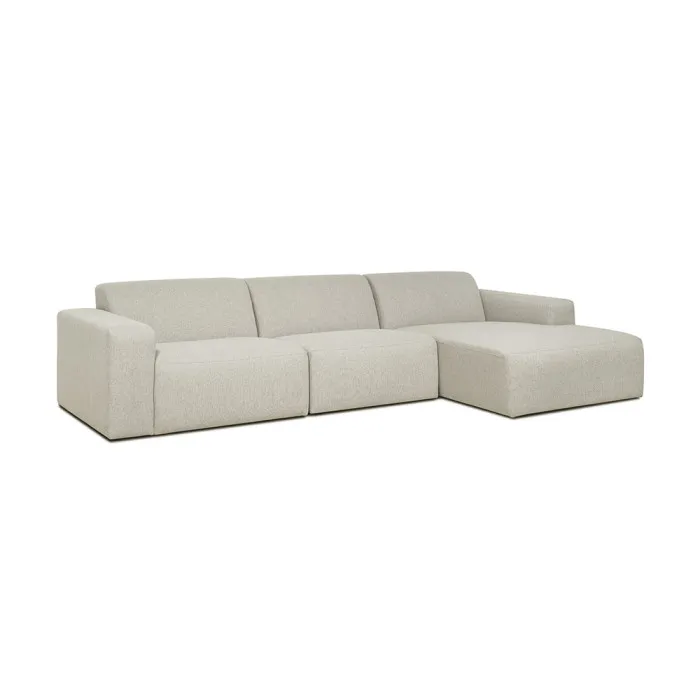
What is a modular sofa?
A modular sofa consists of separate seating, corner, recliner, open end or ottoman elements. When choosing modules, you can adjust the total width, number of seats and sofa orientation in the room.
It is important to check the exact size of each element. Two wide modules may occupy more space than three compact ones, so the configuration should be evaluated in centimeters, not just from seat designations.
Plan the sofa according to daily customs
If the family often watches movies, deep seats, a recliner module or an open corner will be useful. If conversations and gatherings regularly take place in the living room, a straighter, less deep configuration with several separate seats may be more practical.
Also, consider the coffee table, floor lamp, and traffic paths. The shape of the sofa should support the use of the room, not require rearranging the entire living room.
Can a modular sofa be transformed later?
In some collections, it is possible to add a new module later, but it must be confirmed before purchase. The manufacturer may change the construction or fabric collection, and after several years the identical tone may not be available.
If you are planning to move, choose a configuration that can be divided into several usable elements. A universal end module and ottoman are usually easier to adapt than a very specific asymmetrical combination.
Fabric and visual integrity
The surface of a large modular sofa significantly affects the entire interior. Before ordering, view a larger fabric sample both in daylight and artificial lighting.
A pronounced texture can make a large sofa visually more interesting, while a uniform, calm tone allows to easily change decorative pillows, carpet and curtains.
Examples of modular sofas
Different collections allow choosing both a compact corner composition and a very spacious family sofa.
LOFT Sofa (corner L, modular)
LOFT corner L configuration is an example of a modular sofa that can be customized in various sizes and fabrics. This model is suitable for customers who want to precisely balance the number of seats and room size.
Bahama Sofa (U shape, modular)
Bahama U shape configuration demonstrates the possibilities of the modular system in a large living room. Before ordering a model of this size, the room depth, central zone, and delivery path should be checked carefully.
What to specify when ordering a modular sofa
- All module codes and order, looking at the sofa from the front.
- Total width and maximum depth.
- How the modules are connected.
- The setup of armrests and end elements.
- Chosen fabric, seam tone, and leg finish.
- The ability to upgrade the collection in the future.
Frequently asked questions
Can modules be moved every day?
It depends on the connection system. Some modules are designed for stable connection, but puff and separate elements may be more movable.
Is a modular sofa suitable for a small room?
Yes, if compact modules are chosen and the depth appropriate for the room is not exceeded. A modular system itself does not mean a large sofa.
Do all modules have to be in one fabric?
Usually a uniform fabric results in a more harmonious result, but in some collections it is possible to combine tones. It is advised to coordinate such an order with the showroom consultant.
Create a sofa for your living room
Choose modules based on room size and everyday use, not just the catalog image. An accurate configuration scheme before ordering helps to avoid mistakes.